Power BI has become widely used by firms for BI & data visualization, allowing teams to transform complicated data into clear and actionable results. However, understanding the Power BI consulting Chicago cost and overall Power BI implementation cost is essential before starting a BI project, as the budget can vary significantly based on an organisation’s specific requirements. Factors like users, data sources, integrations, dashboards, licensing, and implementation complexity directly affect the final cost. In complex Power BI projects, data preparation and modelling alone can account for around 40–60% of total project effort.
Organizations may also need to account for data preparation, customization, training, and ongoing support. In the next few sections, we will explore the Power BI implementation pricing in the USA for 2026. We’ll talk about estimated costs for different project sizes, available pricing models, factors that influence cost, and additional expenses. Before you invest in Power BI support services in Chicago, read this guide.
What Is Power BI Implementation?
In order to establish a centralized reporting environment, Power BI implementation involves combining business data with Power BI. It includes analyzing and integrating data sources, building data models, producing interactive reports and dashboards, and distributing them to users.
System configuration, data validation, testing, security setup, and user training are all included in the process. Organizations can fix problems, improve performance, update reports, and adapt Power BI to meet evolving business needs with the help of ongoing support and maintenance.
Key Stages of Power BI Implementation
✦ Business requirement analysis
To create precise implementation requirements and priorities, determine the business objectives, reporting requirements, KPI, target users, and expected outcomes.
✦ Data source assessment
Review databases, applications, data quality, formats, availability, and integration to determine how data can be successfully integrated with Power BI.
✦ Data integration and modeling
Establish relationships, connect relevant information sources, clean and transform data, and build scalable data models that enable accurate and effective reporting.
✦ Dashboard and report development
Using suitable visualizations, KPIs, filters, computations, and layouts according to specified business and user requirements, create interactive dashboards and reports.
✦ Testing and optimization
As you find errors and optimize queries, models, dashboards, test data accuracy, report functionality, security, and performance.
✦ Deployment and user training
Implement the Power BI solution in all relevant workspaces, set up user access, and teach staff members how to manage and utilize reports with assurance.
How Much Does Power BI Implementation Cost in the USA?
Depending on project size, integrations, data complexity, and customization, Power BI implementation in the USA can cost from $10,000 to $250,000 or more. Businesses can estimate costs based on their technical environment and reporting requirements with the assistance of a custom Power BI consultant in Chicago. Development and deployment are covered by one-time implementation, whereas licenses, infrastructure, support, and maintenance may be ongoing expenses. The total budget may rise dramatically due to custom requirements.
❏ Small Business Power BI Implementation Cost
When requirements are simple, small businesses usually spend between $10,000 and $25,000 on Power BI consultants in Chicago. Projects typically involve standard dashboards and reports, a small number of users, and simple data integrations. Deployment can frequently be finished more quickly with fewer development resources because the data environment is smaller and implementation complexity is lower.
Businesses that need complex calculations, multiple data sources, custom reports, or more automation could expect higher costs. Businesses should budget for Power BI licensing, continuous maintenance, user support, and future dashboard improvements in addition to implementation fees. A carefully planned implementation helps small businesses keep costs under control while building a reporting foundation that can grow with data and user needs.
❏ Mid-Sized Business Power BI Implementation Cost
Depending on the number of departments, data sources, and reporting needs, mid-sized companies may spend between $25,000 and $75,000 on Power BI implementation. Multiple data integrations, custom dashboards, advanced modeling, and moderate integration requirements are often required for these projects. Role-specific reports and access permissions may also be required by various departments, which would increase development and testing efforts.
When data needs to be significantly transformed before being used in Power BI, the cost of Power BI implementation may increase. Recurring licensing, maintenance, performance optimization, and support costs must be considered. Mid-sized businesses can establish a scalable reporting environment without unnecessary development costs.
❏ Enterprise Power BI Implementation Cost
Implementing enterprise Power BI implementation costs anywhere from $75,000 to $250,000 or more, especially for companies with large data environments and complicated reporting needs. Large user bases, complex data infrastructure, enterprise-level security and governance, advanced analytics, and numerous system integrations are all common components of these projects. Detailed data architecture, governance guidelines, RBA controls, performance optimization, and thorough testing are necessary for implementation.
The Power BI expert in Chicago may charge more when platforms like ERP, CRM, cloud databases, and data warehouses are integrated. Recurring licensing, administration, monitoring, support, and continuous development should all be taken into consideration by businesses. Establishing an accurate implementation budget requires a thorough technical assessment due to the wide variations in requirements.

Power BI Implementation Cost Breakdown
⊛ Power BI Licensing Cost
The number of users, sharing needs, and overall analytics environment all affect how much Power BI licensing costs. While Power BI Pro facilitates teamwork and sharing, Power BI Free is best suited for individual analysis. Larger organizations with more complex capacity and performance requirements are the target audience for Power BI Premium options. Microsoft Fabric capacity should also be taken into account by businesses, especially when Power BI is a component of a larger data and analytics ecosystem. Along with implementation and continuing operating costs, licensing should be assessed.
⊛ Power BI Consulting Cost
The level of technical and strategic expertise required determines the cost of Power BI consulting. Consultants can assist companies in defining reporting goals, identifying appropriate Power BI capabilities, and creating a BI strategy. While data assessment finds integration, quality, and performance problems, architecture planning ensures that the platform can handle present and future workloads. Security, governance, deployment, performance optimization, and best practices are included in technical consulting. Companies with complicated environments might need more consulting time, which would raise the implementation budget as a whole.
⊛ Dashboard Development Cost
The number of dashboards, report complexity, and degree of customization required all affect dashboard development costs. In general, less development work is needed for simple dashboards that use pre-existing datasets and standard charts. Custom visualizations, thorough computations, interactive features, and role-based reporting are examples of more complex projects. Development time may also be impacted by the quantity of data and the number of stakeholders. To create a realistic budget and prevent unexpected costs during development, businesses should specify dashboard requirements early on.
⊛ Data Integration Cost
When data is distributed across several business systems, data integration may be responsible for a significant portion of the Power BI implementation budget. The project’s costs vary depending on whether it incorporates databases, cloud apps, ERP and CRM integration, or third-party platforms. Different connectors, authentication techniques, transformation rules, and testing may be needed for each source. Identifying integration issues and estimating the resources required for reliable, automated data flow are made easier with a thorough evaluation of current systems.
⊛ Data Migration and Preparation Cost
The amount and structure of current business data determine the costs associated with data migration and preparation. Organizations may require data transformation, migration, cleaning, and quality improvements prior to generating reports. Mapping legacy data structures to new models and verifying the migration’s outcomes may also be necessary for complex migrations. Investing in appropriate data preparation strengthens the foundation for long-term Power BI analytics and increases report accuracy.
⊛ Training and Support Cost
Organizations can ensure that employees can use and manage their Power BI environment after implementation by investing in training and support. While administrator training can cover workspace management, security, governance, and deployment, user training can cover dashboard navigation, filtering, report interaction, and basic analysis.
Companies may also need technical assistance for performance problems and troubleshooting. Updating reports, changing data sources, adding new requirements, and fixing technical issues are all examples of ongoing dashboard maintenance. The complexity of the Power BI environment and internal expertise will determine the necessary level of support.
Also Read : 7 Best Power BI Consulting Companies in Las Vegas
Key Factors Affecting Power BI Implementation Cost
⇒ Number of Users
The implementation and licensing costs of Power BI are directly impacted by the number of users. Increased infrastructure capacity and licensing may be necessary for larger user groups, especially when numerous employees access reports at once. Depending on their needs for collaboration, sharing, and reporting, different user roles might also need different Power BI plans. Before choosing a licensing option, businesses should identify the administrators, analysts, and viewers. Carefully planning user access can help businesses manage ongoing expenses while ensuring that employees are capable of fulfilling their duties.
⇒ Number of Data Sources
Implementation costs can be greatly impacted by the quantity and kind of data sources. Integration complexity rises when multiple systems are connected, particularly when data originates from databases, ERP platforms, CRMs, cloud apps, or third-party tools. Before information can be used efficiently, legacy systems may need further development, custom integrations, APIs, or data transformation. Power BI consultants in Chicago are able to evaluate current data environments, identify integration issues, and suggest practical solutions. While establishing reliable data flow into Power BI, a well-defined integration strategy can minimize development effort.
⇒ Dashboard and Reporting Complexity
Development time and expense are directly impacted by dashboard and reporting complexity. In general, fewer resources are required for basic dashboards that use pre-existing datasets, tables, charts, and filters. Custom computations, interactive features, and multiple reporting views are examples of advanced reports.
Additional data modeling, DAX development, testing, and performance optimization are often required for complex requirements. Before development starts, organizations should specify their reporting needs. In addition to preventing significant redesign, a clear scope helps teams accurately estimate costs.
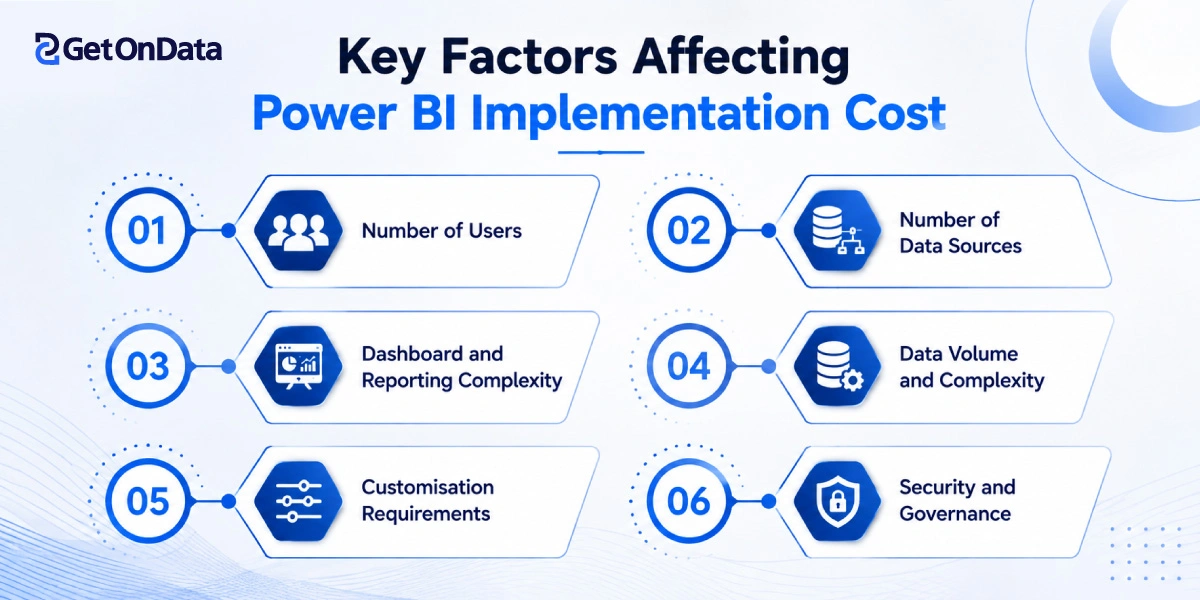
⇒ Data Volume and Complexity
Large data volumes may require a more robust architecture, optimized data models, and meticulous performance planning, which can raise the cost of implementing Power BI. Multiple tables, inconsistent formats, and historical records that require extra work are examples of complex datasets.
When information needs to be thoroughly cleaned, restructured, or validated, data transformation can also result in longer development times. When designing their Power BI environment, businesses should evaluate both present and anticipated future data volumes. As reporting needs and datasets expand, designing for scalability from the start can help maintain consistent performance.
⇒ Customization Requirements
The total cost of implementing Power BI can be significantly increased by customization. To satisfy particular operational requirements, businesses might need role-based dashboards, advanced DAX computations, custom graphics, or embedded analytics. Additional design, development, testing, and performance optimization are frequently needed for these features.
Additionally, technical requirements related to user access, authentication, and applications may be introduced by embedded analytics. Before development starts, organizations should differentiate between necessary custom features and optional improvements. While ensuring that the finished Power BI solution satisfies crucial business requirements, a well-defined scope helps in cost control.
⇒ Security and Governance
Implementing Power BI can be made much more difficult by security and governance requirements, especially for companies that deal with sensitive data. Row-level security, data access controls, governance frameworks, and compliance requirements are a few examples of requirements. User permissions, workspace configurations, authentication, data policies, and monitoring procedures may all need to be set up by teams.
Further testing is necessary in more complex environments to make sure users can access the appropriate information without disclosing restricted data. Organizations can create a controlled Power BI environment and lower the risk of expensive changes after deployment by establishing security and governance requirements.
Power BI Implementation Pricing Models in the USA
✧ Fixed-Price Model
Power BI projects with well-defined requirements, deliverables, deadlines, and scope are best suited for the fixed-price model. Businesses have more predictable implementation costs because the provider agrees on a project cost before development starts. This method works well for projects with few anticipated changes, defined data integrations, and standard dashboard development. However, there may be additional fees for requirements that go beyond the scope of the agreement. Therefore, before entering into a fixed-price contract, businesses should thoroughly document technical requirements and deliverables.
✧ Hourly Pricing Model
Businesses with flexible or changing Power BI requirements can benefit from the hourly pricing model. Businesses pay according to the number of consultant or developer hours used rather than a single project fee. This strategy is effective when organizations occasionally require technical support or when requirements may change during implementation. The provider’s hourly rates, level of experience, and total number of hours are required to determine the cost. Despite the model’s flexibility, companies should set spending caps, milestones, and projected hours in order to better manage their budgets.
✧ Dedicated Team Model
Large or ongoing Power BI projects that need ongoing development and support are a good fit for the dedicated team model. BI experts who can work on dashboards, data modeling, integrations, testing, and enhancements are regularly available to businesses. Compared to hiring resources for specific tasks, this method offers more flexibility and enables the team to gain a deeper comprehension of business requirements. Businesses with constantly changing analytics requirements may find it especially beneficial.
✧ Managed Power BI Services
After the initial implementation, managed Power BI services offer continuing support. Dashboard management, performance tracking, technical assistance, optimization, security management, and the creation of new reports are a few examples of services. Businesses can rely on an outside team for routine management and upgrades rather than maintaining the entire Power BI environment internally. Organizations that lack specialized Power BI experts or require consistent, continuous support can benefit from this model. Depending on users, workloads, service scope, and support needs, pricing may be set as a monthly or annual fee.
In-House vs Power BI Implementation Partner Cost
The complexity of the project, internal knowledge, schedule, and long-term support needs all play a role in the decision between an in-house team and a Power BI implementation partner. Although internal implementation offers direct control, working with experts can speed up deployment and lower the learning curve.
➥ In-House Implementation
Although an in-house enterprise Power BI implementation cost analysis might seem less at first, companies must take into account the entire cost of hiring and retaining an internal team. Salary, recruitment, benefits, and onboarding are examples of in-house hiring expenses. Depending on team size and skill level, an in-house approach could cost between $30,000 and $100,000+ per year for a small or simple project.
➥ Power BI Implementation Partner
A Power BI implementation partner gives companies access to specialized knowledge without requiring them to establish an entire internal team. Skilled experts can manage complex integrations, speed up deployment, and effectively address technical difficulties by utilizing established implementation procedures. The implementation partner may normally cost between $10,000 and $250,000+, depending on the project’s scope.
Power BI Implementation Cost by Project Complexity
◈ Basic Implementation
Businesses with simple reporting needs can benefit from a basic Power BI implementation. These projects usually have a small number of users, standard reports, few data sources, and minimal customization. Depending on the needs for data preparation and integration, a standard basic Power BI implementation in the USA could cost between $10,000 and $25,000.
◈ Moderate Implementation
Multiple systems, custom dashboards, data modeling, and automated reporting are typical components of a moderate Power BI implementation. Depending on the quantity of integrations, users, dashboards, and unique needs, moderate Power BI projects in the USA can normally cost between $25,000 and $75,000.
◈ Complex Enterprise Implementation
Large organizations must adhere to strict technical and reporting requirements for complex enterprise implementations. Large-scale integrations, advanced analytics, and enterprise security are a few examples of these projects. In the United States, enterprise Power BI implementations can cost up to $75,000.
Additional Power BI Costs Businesses Should Consider
Budgets for Power BI can go beyond the initial deployment. Upgrades to Microsoft licenses, data warehouse development, Microsoft Fabric services, cloud infrastructure, third-party and API integrations, and custom integrations should all be taken into consideration by businesses. Dashboard maintenance, user training, Power BI support services Chicago, performance optimization, and future improvements could all be considered ongoing costs.
As analytics needs change, working with custom Power BI consultants Chicago can help organizations better plan their budgets. They help to identify these extra requirements early and prevent unnecessary expenses.
How to Estimate Your Power BI Implementation Budget
➤ Define Business Objectives
Determine the particular business issues Power BI needs to address, such as enhancing reporting and decision-making. Establish measurable outcomes to assess whether the implementation adds significant business value.
➤ Identify Data Sources
Identify every database, cloud application, CRM, and ERP system that will be connected to Power BI. Before estimating costs, consider data availability, quality, transformation requirements, and integration complexity.
➤ Define Dashboard Requirements
Identify the dashboards, KPIs, reports, and visualizations that various teams need. To prioritize development and improve budget control, keep essential reporting features apart from optional ones.
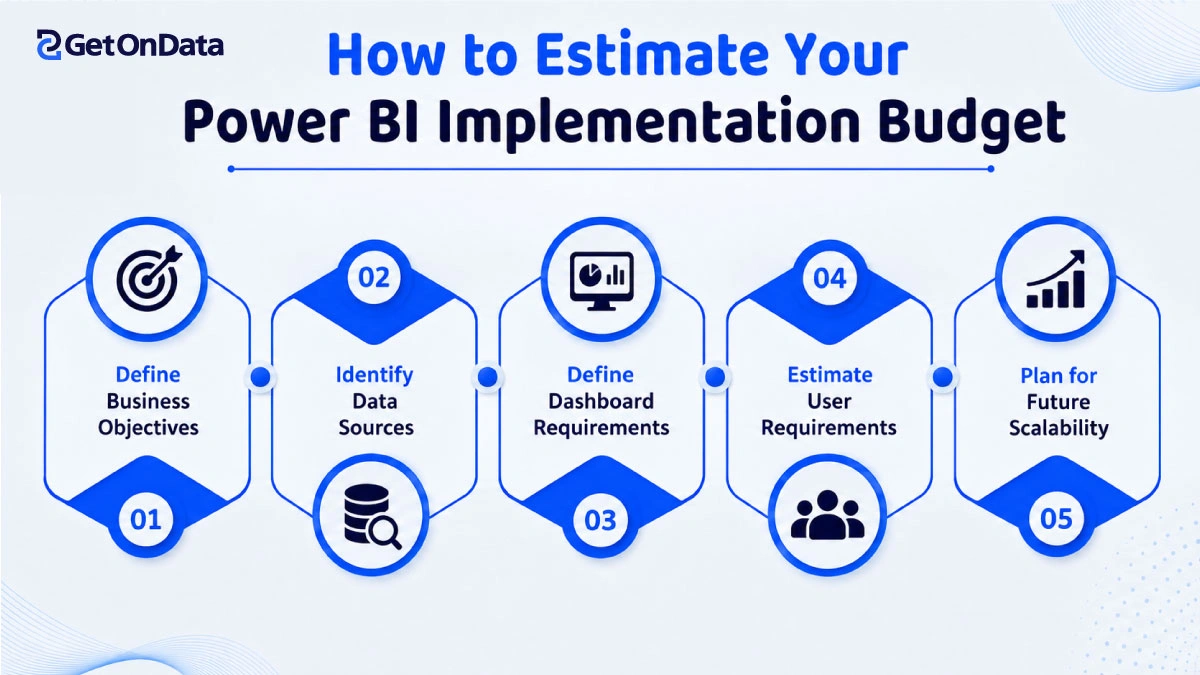
➤ Estimate User Requirements
Determine the number of employees who will view dashboards and identify the report creators. Take into consideration the administrators responsible for managing workspaces, permissions, security, and governance.
➤ Plan for Future Scalability
When creating the Power BI environment, take future users, departments, reporting needs, and growing data volumes into consideration.
How to Reduce Power BI Implementation Costs
➔ Start with high-priority dashboards
Instead of creating every report at once, concentrate first on dashboards that address important business needs and provide immediate value.
➔ Clean and organize data before implementation
Transformation work, development time, and unexpected integration costs can all be decreased by preparing precise, organized, and consistent data in advance.
➔ Clearly define project requirements
To reduce scope changes, rework, and additional development costs, establish dashboards, KPIs, users, integrations, and technical requirements early on.
➔ Avoid unnecessary customization
Whenever possible, ensure the use of standard Power BI features. Complex features and unique graphics should only be included when they clearly add value to the business.
➔ Use reusable dashboard templates
Standardized templates can speed up development, maintain departmental consistency, and reduce time needed to repeatedly create reports that are similar.
➔ Select the right Power BI licensing model
Evaluate users, workloads, sharing needs, and capacity requirements in order to select licensing that offers essential functionality without charging for features that aren’t utilized.
➔ Implement the project in phases
Businesses can prioritize critical functionality, control spending gradually, and adjust requirements based on initial findings by using a phased approach.
➔ Work with an experienced Power BI implementation partner
A skilled Power BI implementation partner can increase development, suggest economical fixes, and help in the project’s successful completion.
Is Power BI Implementation Worth the Cost?
By eliminating manual reporting and establishing a single source of business data, Power BI may be worth the investment. Real-time insights increase team reporting efficiency and decision-making. Companies can identify trends and performance gaps more quickly, which gives leaders more confidence to adapt to changing circumstances. Power BI facilitates data-driven business growth and helps organizations make better strategic and operational decisions by converting complex data into actionable insights.
Also Read : How Much Does Data Analytics Cost in the USA in 2026?
How to Choose a Power BI Implementation Partner in USA
⦾ Review Power BI and Microsoft expertise
Select a partner who has proven expertise with Power BI and Microsoft, including data modeling, DAX, Microsoft Fabric, integrations, security, and deployment.
⦾ Check industry-specific experience
Give preference to partners with industry experience. They are better able to develop Power BI solutions that better suit business needs because of their familiarity with compliance requirements, KPIs, and reporting challenges.
⦾ Evaluate previous Power BI projects
Review successfully completed Power BI projects to evaluate the partner’s skills, dashboard quality, integration experience, and capacity to manage projects.
⦾ Understand their implementation methodology
Enquire about the approach of a Power BI expert in Chicago to discovery, planning, development, testing, deployment, and optimization. Clearer communication, clearly defined roles, controlled schedules, and more efficient project delivery are all supported by an organized implementation methodology.
⦾ Compare pricing and engagement models
Depending on the needs of the project, compare managed, hourly, fixed-price, and dedicated team service models. Before choosing an engagement strategy, consider total costs, deliverables, flexibility, and possible extra fees.
⦾ Check post-implementation support capabilities
Verify whether the partner offers continuous technical support, dashboard maintenance, performance optimization, troubleshooting, user training, and improvements. Power BI performance and usability are maintained with the support of reliable post-implementation services.
⦾ Ensure they can support future scalability
Select a partner who can manage expanding departments, users, data volumes, integrations, and analytics needs. As business needs change, scalable architecture and long-term experience can minimize expensive redevelopment.

Ready to Plan Your Power BI Implementation with Confidence?
Power BI implementation cost in the USA depends on project challenges, data sources, users, integrations, licensing, and custom requirements. Organizations must plan for both initial implementation & ongoing expenses such as support, optimization, and maintenance. Partnering with skilled Power BI consulting Chicago allows firms to develop a realistic budget and scalable strategy. Rather than selecting a provider based on lower charges, focus on long-term ROI, performance, and business value.