The cost of data analytics in the USA can range from a few thousand dollars for a specific dashboard project to several hundred thousand dollars for an enterprise analytics program. One engineer and a lean startup run on $12k-$17k a month with open source tools. A mid-market company is likely to spend between $57,000 and $105,000 per month. A large organization, with AI pipelines and a dedicated team, spends $240,000 to $700,000 per month or more.
The answer to why businesses are putting more emphasis on data analytics in 2026 is simple: to survive. According to a McKinsey report, businesses that use data to inform their decisions are 23% more profitable than those that don’t. These businesses also experience a 19% higher growth rate.
The final bill is based on the volume of data, complexity of your systems, and infrastructure options. Building an in-house team requires significantly greater financial investment compared to outsourcing workers. There are also one-time custom build fees that can range from $150,000 to $250,000 without any additional monthly charges.
In this pricing guide, you will discover the five layers behind every data analytics cost and how generative AI can totally upend your budget. We will take a deep dive into the specifics of purchasing data analytical services without overspending on unused compute power. By the end of this guide, you will be able to hire data analytics services and solutions for a huge ROI.
What Is Included in Data Analytics Services?
When you hire professionals, you pay for a complete system, not just a software license. Reliable platforms combine data collection, deep cleaning, visual reporting, and AI-driven forecasting. Each of these layers bills differently. You must understand all of them to know if a vendor offers you a fair price.
✦ Data Collection & Integration
All successful projects start with extracting data from silos. The top data analytics agencies create safe and secure pipelines to carry your data into a central repository that analysts can access.
◈ Data extraction: Engineers import your raw data from your CRM, point-of-sale, and advertising platforms, and internal databases so you can get a full picture of your whole business.
◈ ETL/ELT processes: The specialized software extracts your data, reorganizes content uniformly, then deposits everything inside protected storage facilities.
◈ API integrations: Developers build direct bridges between your live systems. This allows real-time or near-real-time syncing, which means that your dashboards get updated as soon as a customer is buying.
Ingestion tools like Fivetran and Airbyte automate this work using pre-built connectors. But prices have varied greatly in recent times. Fivetran now charges Monthly Active Rows (MAR) on a per-connector basis rather than from an account. For companies with multiple connectors, this single change increased ingestion cost by 40-70%. Even if you are only syncing a small connector, containing under one million rows, you are still charged at least $5.
✦ Data Cleaning & Preparation
Raw data is seldom ready for analysis. Doing any chart without preparing the numbers is like making a house without a foundation. This stage is labor-intensive and accounts for 30-40% of total project hours.
◈ Removing duplicate and inaccurate data: Experts clean your data before it ever makes it into any dashboard by removing any duplicate or inaccurate data. This means that your sales team will not follow up with the same customer twice.
◈ Data transformation: Engineers reshape and standardize fields across entirely different systems. They make sure a date formatted in your CRM perfectly matches the date format in your billing software.
◈ Data validation: Analysts catch broken arrangements, absent values, and unusual anomalies early. This gives your team a more reliable basis for decision-making.
Skipping this stage ruins projects. You will end up with a beautiful dashboard that delivers confident, wrong answers. High-quality data preparation justifies your initial data analytics price because it protects your business from costly mistakes.
✦ Data Visualization & Reporting
Experts use data analytical services to create visual tools that your non-technical personnel can interpret and comprehend.
◈ Interactive dashboards: Managers can click, filter, and drill down into the data. They can see sales figures by region, product line, or time frame, without having to request a new report from IT.
◈ KPI reports: These reports monitor your growth and the actual data. You see your customer acquisition cost and churn rate clearly displayed in one place.
◈ Executive reporting: High-level summaries of information present millions of data points on one page for the leaders. A successful executive dashboard will meet the 5-second rule, which means that executives can see the performance within minutes.
In this area, tools such as Tableau and Power BI reign supreme. They charge by user seat, not so much by data volume. This puts your visualization budget as extremely predictable.
✦ Predictive & Advanced Analytics
Once you master your historical data, you want to know what happens tomorrow. Advanced teams use complex mathematics to foretell future business results.
◈ Forecasting: Analysts predict future demand, revenue trends, and inventory needs.
◈ Machine learning models: Engineers build algorithms that flag financial risk or surface hidden buying patterns. These models find opportunities that humans simply cannot see.
◈ Customer behavior analysis: Managers forecast what buyers might cancel their subscriptions next month. This allows your retention personnel to retain vulnerable profiles before they leave.
This tier requires expensive data science expertise. Generative AI adds a massive new cost category here. If you route a heavy workload to a flagship model like GPT-4o, you might pay $33,750 a month. If you route that exact same task to an efficiency model, the job only costs $1,000. Model selection serves as a critical cost-engineering decision today.
How Much Does Data Analytics Cost in the USA?
The final bill climbs in steps tied directly to your data volume. Each new step requires a different software stack and a larger team.
❏ Cost by Business Size
• Small Businesses: Early-stage companies spend $12,000 to $17,000 a month. If you generate under 500 Gigabytes of data, you only need one analytics engineer, open-source tools, and a pay-as-you-go warehouse. Personnel makes up almost the entire budget.
• Mid-Sized Companies: Growing brands spend $57,000 to $105,000 a month. As data volume and workload complexity increase, businesses may adopt cloud data warehouses such as Snowflake, BigQuery, or Microsoft Fabric. You also need a specialized data team of three to five people.
• Large Enterprises: Massive corporations spend $240,000 to over $700,000 a month. Companies managing Petabytes of data require multi-engine lakehouses. They also employ centralized platform teams of 10 to 25 highly paid specialists.
The cost of data analytics depends on data sources, users, integrations, security requirements, and the level of ongoing support.
❏ Cost by Project Type
If you only need a specific solution, you can hire experts for one-off projects. If your project starts with fragmented, duplicate-heavy records, expect to pay the higher end of these ranges.
• One-time analytics project: A deep data audit or reporting cleanup costs $5,000 to $15,000.
• Dashboard development: Building a custom dashboard for a single department costs $8,000 to $30,000.
• Business Intelligence implementation: Rolling out a full BI strategy across multiple teams costs $30,000 to $120,000.
• Predictive analytics: Building forecasting models requires data scientists. This heavily specialized work costs $100,000 to $400,000.
• Real-time analytics: Streaming fresh data by the second requires complex infrastructure like Kafka. This extreme speed costs $80,000 to $200,000 or more.
❏ Monthly Managed Analytics Services
Many businesses prefer predictable monthly retainers. They hire top data analytics agencies to manage their systems continuously instead of dealing with full-time payroll.
• Starter plans: You pay $1,500 to $5,000 a month for basic reporting and light advisory support.
• Growth plans: You pay $6,000 to $20,000 a month for more dashboards, faster turnaround times, and dedicated analysts.
• Enterprise solutions: You pay $30,000 or more a month for priority support, custom service level agreements, and full pipeline management.
If you search for data analytics services in Chicago, you will find that local boutique firms align closely with these national pricing bands.
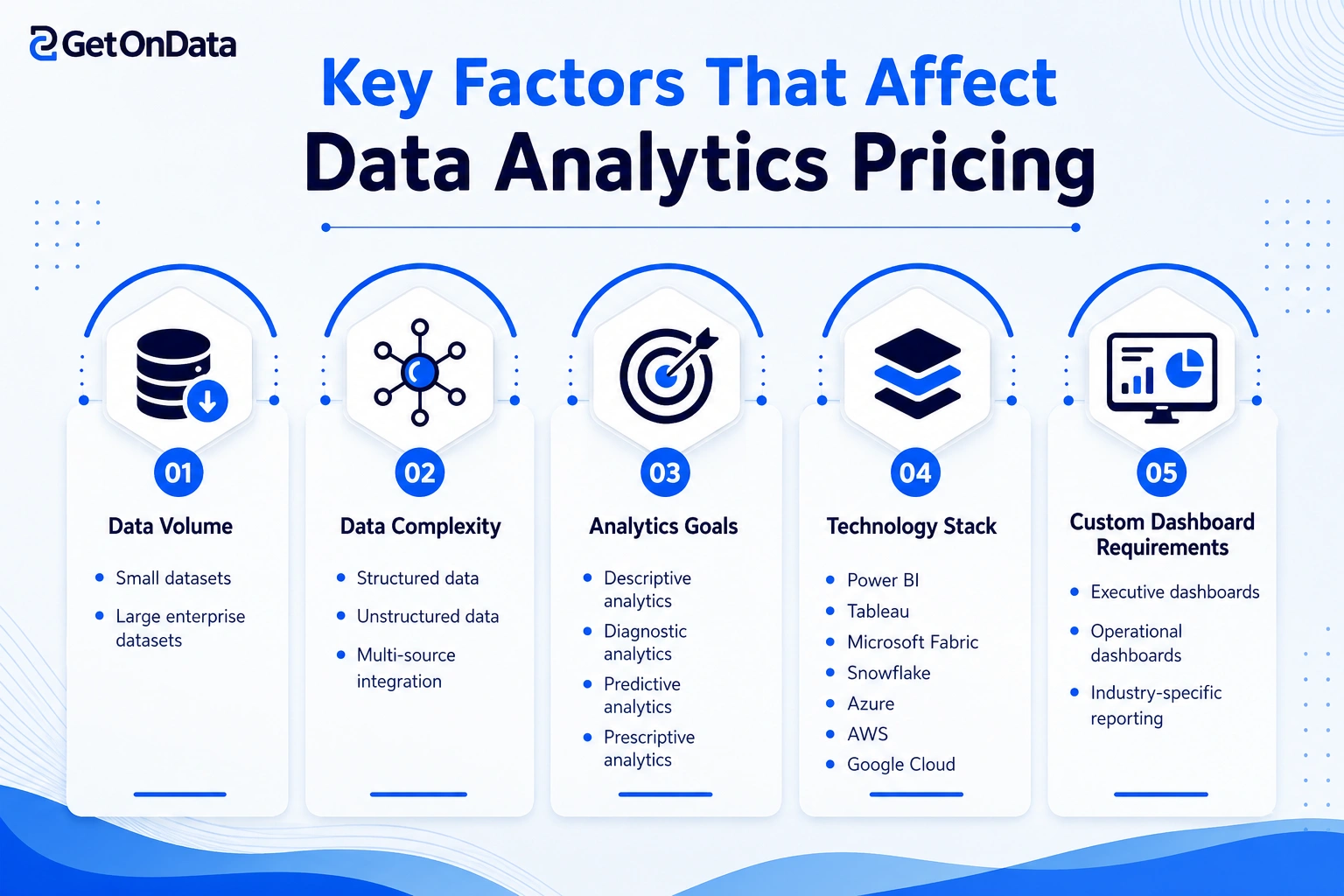
Key Factors That Affect Data Analytics Pricing
There are multiple technological factors that influence your end data analytics cost. Knowing these factors will help you avoid being overcharged by vendors.
⇒ Data Volume
⊛ Small datasets: Processing a few Gigabytes costs virtually nothing. Any modern platform can store and query small datasets cheaply.
⊛ Large enterprise datasets: Terabytes of data require special infrastructure and partitioning strategies. Cost scales non-linearly. Whether you are doubling data volume or not, your total analytics cost will not double just because of the storage. This is because compute, query patterns, data movement, and concurrency are also major factors.
Also Read : Benefits of Data Analytics for Building a Data-Driven Organization
⇒ Data Complexity
⊛ Structured data: It refers to information that is neatly stored in relational tables, which is the least expensive to analyze. Most BI tools are able to spin up and connect with structured data immediately.
⊛ Unstructured data: Text reviews, images, and audio files are more difficult to extract and analyze. Processing this messy data frequently doubles your total project cost.
⊛ Multi-source integration: Linking totally disjointed systems is an enormous engineering task. New mapping logic and new validation rules are needed for every new source of software.
⇒ Analytics Goals
⊛ Descriptive analytics: There’s an initial cost of $30,000 to $120,000 just to track what happened yesterday. It is still the most affordable reporting level.
⊛ Diagnostic analytics: Explaining exactly why an event happened costs $80,000 to $250,000. This involves having highly structured and complicated data models.
⊛ Predictive analytics: Forecasting what will happen tomorrow costs $100,000 to $400,000. There’s a cost to expensive machine learning technology.
⊛ Prescriptive analytics: Recommending the exact actions a business must take costs $200,000 to $800,000. This combines advanced forecasting with optimization logic.
⇒ Technology Stack
Your platform choices change your budget instantly. Depending on the provider, region, storage class, number of requests, retrieval, and data transfer, standard object storage can cost about $20 to $25 per TB per month in some U.S. regions. It costs only $200 – $400 per month to store 10 Terabytes of historical data.
⊛ Power BI: Microsoft charges $14/month for Power BI Pro users and $24/month for Power BI Premium users.
⊛ Tableau: Salesforce offers simple Viewer seats at $15 per month and Creator seats at $75 per month.
⊛ Microsoft Fabric: This enterprise capacity ranges from $263 per month up to approximately $4,995 per month.
⊛ Snowflake: You pay $2 to $4 per compute credit, depending on the edition.
⊛ Azure, AWS, and Google Cloud: These platforms bill compute and storage separately. An unmonitored query spikes your cloud data analytics cost in minutes.
An improperly configured Warehouse increases your Google data analytics cost overnight.
⇒ Custom Dashboard Requirements
⊛ Executive dashboards: Dashboards that have fewer moving components and are designed to make quick decisions have the lowest development cost.
⊛ Operational dashboards: Building and maintaining operational dashboards with granular, real-time metrics for a warehouse floor is far more expensive.
⊛ Industry-specific reporting: Dashboards in different sectors like healthcare and finance, for example, need to have regulatory logic. Developers have to create audit trails and enforce access control, which increases the cost.
Data Analytics Pricing Models
Agencies and consultants package their fees differently. You must choose a billing model that matches your corporate goals. Look for a firm offering elite web analytics consulting Chicago to guide you through these options.
➥ Fixed Price Projects
✧ Best for defined scope: You receive a single dashboard build or a deep data audit with clear, guaranteed deliverables.
✧ Predictable budgeting: You know the exact total cost before engineers begin working. Your finance team appreciates the lack of surprises. However, this model handles sudden scope changes poorly.
➥ Hourly Pricing
✧ Suitable for consulting: You pay for discovery work where the initial findings shape the next steps.
✧ Short-term engagements: Consultants typically bill $50 to $350 an hour. A junior freelancer cleaning a spreadsheet charges $50 an hour. A senior AI architect building machine learning models commands $350 an hour. This model works beautifully for fast, surgical fixes.
➥ Dedicated Analytics Team
✧ Long-term projects: You lease an entire team that functions as an extension of your own staff. You gain steady, predictable output.
✧ Continuous optimization: The team constantly improves your pipelines and models. The cost of a typical external team is less than the $38,000 to $55,000 per month that you would spend on fully loaded in-house salaries.
➥ Monthly Retainer
✧ Ongoing reporting: You receive fresh insights every single month without having to negotiate a new contract. This type of model is highly stable.
✧ Dashboard maintenance: The agency instantly repairs your dashboards when a source system changes or a software update causes a problem with your dashboard.
✧ Continuous improvements: Your data infrastructure expands effortlessly, along with the evolving demands within commercial operations. Ultimately, the data analytics price is a function of the amount of hours logged: overheads are just the retainer’s billing mechanism. Find a solid web analytics consulting Chicago partner to manage this ongoing relationship.
Hidden Costs Businesses Should Consider
Many leaders just put aside money for Software Seats and Salaries. Good data analytics cost management means thinking about costs that are not always obvious and end up damaging profitability. McKinsey research indicates that a midsize institution with $5 billion in operating costs invests over $250 million annually in data.
➔ Data migration: When you’re moving data from legacy systems to a modern cloud warehouse, you always uncover messy, broken records. Fixing these errors forces teams into expensive remediation cycles.
➔ Third-party software licensing: Tools for BI, ETL pipelines, and AI add-ons stack up quickly.
➔ Cloud storage: Historical data accumulates faster than you expect. This means that your cloud data analytics cost steadily increases over time.
➔ API integration costs: Niche software systems can be integrated via APIs, which involves custom coding and usage fees for every month.
➔ User training: If your employees don’t know how to use the tools, you’re wasting all of your investment. You must pay to train them properly.
➔ Dashboard maintenance: Upstream systems constantly change their schemas. You must pay engineers to fix the dashboards when they inevitably break.
➔ Security & compliance: Regulated industries must pay for encryption, audit logs, and expert compliance reviews.
➔ Ongoing support: You need experts available to troubleshoot failing pipelines and update logic as business needs shift.
You must also budget for data observability tools. This software catches broken pipelines before they reach your dashboard. Entry-level observability tools run $25,000 to $60,000 a year. Without serious data analytics cost management, these combined hidden fees will add 20% to 30% to your first-year budget.
Cost Comparison: In-House Team vs Data Analytics Company
You have two paths. You can hire employees, or you can hire an external firm. We partner with the best data analytics companies Chicago has to offer, and we know exactly how the math works for both options.
◈ In-House Analytics Team
Building your own department requires a massive, ongoing financial commitment.
➤ Hiring costs: A single senior data engineer in the U.S. earns $100,000 to $140,000 a year in base salary alone. A senior data scientist commands $150,000 to $175,000 or more.
➤ Software expenses: Tool licensing sits directly on top of those salaries. You buy every single seat yourself.
➤ Infrastructure: For businesses using Google Cloud, the overall Google data analytics cost depends on storage, compute, queries, data movement, and the analytics tools selected.
➤ Training: New hires require three to six months of ramp-up time before they become fully productive. You pay their full salary while they learn your systems.
A small internal team of just three specialists easily exceeds $300,000 a year before they build a single dashboard.
◈ Data Analytics Partner
Hiring top external experts changes your financial trajectory completely. When you buy premium data analytics services and solutions, you unlock immediate advantages.
➤ Faster implementation: Specialists arrive already trained on the exact tools you need. They start building your pipelines on day one.
➤ Access to specialists: You gain access to data engineers, visualization experts, and data scientists simultaneously without hiring each role separately.
➤ Lower operational costs: You achieve a blended rate that heavily undercuts the cost of building an elite in-house bench.
➤ Scalability: You increase the team size during a massive migration project, then scale them down when the work finishes. You never pay for idle employees.
Businesses evaluating top data analytics companies Chicago teams provide often reach data maturity a full year faster than companies building in-house.
Also Read : Top Data Analytics Companies in Houston to Watch in 2026
How to Reduce Data Analytics Costs Without Compromising Quality
With smart data analytics cost management, you don’t have to compromise on accuracy to safeguard your cash flow. You can often reduce your unnecessary analytics spending by auditing unused dashboards, idle compute resources, and getting software licenses.
⊛ Start with clear business objectives: Don’t begin any project with a weak objective such as ‘get more insights’. Make sure every single dollar spent maps directly back to a decision your business actually needs to make.
⊛ Focus on “high value” dashboards: Don’t create reports no one reads. It’s better to have a few well-used dashboards than lots of abandoned ones.
⊛ Use scalable cloud platforms: Select platforms that charge you only for what you use. Avoid paying for compute power that is not in use for most of the month.
⊛ Automate repetitive reporting: Cut the manual hours that inflate your retainer. Save your analysts from manually exporting spreadsheets to do high-value data science work.
⊛ Select the proper analytics partner: The lowest hourly rate doesn’t always produce the lowest overall cost. Low-cost developers lead to rework, delays, and broken pipelines.
⊛ Reuse existing data infrastructure: Avoid rebuilding pipelines that are already working well. Reserve your new infrastructure spend for genuine capability gaps.

Make the Right Data Analytics Investment for Your Business
The final expenses depend on your corporate scale, information complexity, and your technology stack. Because no two companies have the same infrastructure, no two companies pay the same cost of data analytics. According to industry research, the average ROI of analytics investments is almost 120% in the first two years. Firms that take the leap on data post a 23% greater profitability.
We strongly encourage businesses to evaluate goals before selecting a provider. Do you need a simple reporting dashboard, or do you need a predictive machine learning engine? Define your success metrics clearly. A useful benchmark involves comparing the quote against your revenue. Most mature data analytics companies in Chicago dedicate 2% to 6% of total operating expenses to data analytics.
Need help estimating your analytics budget? Qualified data analytics services in Chicago can evaluate your data sources, reporting needs, technology constraints, and growth strategies to provide a data analytics recommendation. Contact our representatives and get customized quotes regarding your project, instead of a generic pricing package.